Proper Scoring Rules: Evaluating Probabilistic Forecasts in Energy Markets

Python
Statistics
Data Science
Energy
Machine Learning
Forecasting
Author

Jan Schlegel

Published

March 13, 2026

Abstract
We examine the application of proper scoring rules in evaluating probabilistic forecasts within energy markets. These rules provide a rigorous framework for assessing the quality of probabilistic predictions, ensuring that forecasters are incentivized to provide accurate and well-calibrated probabilities. Our focus lies on the Continuous Ranked Probability Score (CRPS) and its multivariate generalizations — the Energy Score and Variogram Score — with practical examples from electricity price and wind power forecasting.

1 Introduction

In many real-world decision problems — from dispatching power plants to hedging financial positions — what matters is not a single point forecast but a full probabilistic forecast that quantifies the uncertainty around future outcomes. A probabilistic forecast issues a predictive distribution \(F\) for a future quantity \(Y\), and the natural question becomes: how do we evaluate such forecasts?

Point forecasts are commonly assessed by the mean absolute error (MAE) or root mean squared error (RMSE). But these metrics are blind to the shape, spread, and calibration of a predictive distribution. A well-calibrated 90% prediction interval that is too wide is useless for trading; a tight interval that misses 30% of observations is dangerously overconfident. We need evaluation tools that reward the full predictive distribution — and penalize misspecification of any of its features.

Scoring rules provide exactly this framework. A scoring rule \(S(F, y)\) assigns a numerical penalty (or reward) to a forecast distribution \(F\) when the outcome \(y\) materializes. The key requirement for a proper scoring rule is that it incentivizes honesty: the forecaster’s expected score is optimized when the issued forecast \(F\) coincides with the true data-generating distribution \(G\). This property is fundamental for principled forecast evaluation and comparison (Gneiting and Raftery 2007; Winkler et al. 1996).

In this post we develop the theory of proper scoring rules from the ground up, survey the most important examples — Brier Score, Logarithmic Score, CRPS, Energy Score, and Variogram Score — and discuss essential diagnostic tools: PIT histograms for calibration assessment and the Diebold-Mariano test for formal model comparison.

2 Proper Scoring Rules

2.1 Setup and Core Definitions

Let \(\mathcal{F}\) denote a convex class of probability distributions on \(\mathbb{R}^d\) and let \(y \in \mathbb{R}^d\) be the verifying observation.

Definition (Scoring Rule)

A scoring rule is a function \[ S: \mathcal{F} \times \mathbb{R}^d \to \overline{\mathbb{R}}, \] where \(S(F, y)\) quantifies the quality of the predictive distribution \(F\) when the outcome \(y\) is observed. By convention we adopt the negatively oriented framework: lower scores indicate better forecasts.

The expected score under the true distribution \(G\) is \[ S(F, G) = \mathbb{E}_{Y \sim G}[S(F, Y)]. \]

Definition (Propriety) (Gneiting and Raftery 2007)

A scoring rule \(S\) is proper relative to \(\mathcal{F}\) if \[ S(G, G) \leq S(F, G), \qquad \forall\, F, G \in \mathcal{F}, \] i.e. the expected score is minimized when the forecast \(F\) equals the true distribution \(G\).

It is strictly proper if equality holds only when \(F = G\).

Propriety guarantees that a forecaster cannot improve their expected score by hedging — issuing a distribution different from their true belief. Strict propriety goes further: it ensures that only the true distribution achieves the optimum, making the scoring rule a faithful evaluation tool.

Theorem (Characterization via Divergence) (Gneiting and Raftery 2007)

A scoring rule \(S\) is proper if and only if the divergence function \[ d(F, G) = S(F, G) - S(G, G) \] satisfies \(d(F, G) \geq 0\) for all \(F, G \in \mathcal{F}\), with \(d(G, G) = 0\).

For a strictly proper scoring rule, \(d(F, G) = 0 \iff F = G\).

The divergence \(d(F, G)\) measures the penalty for misspecification: the excess expected loss incurred by reporting \(F\) when the truth is \(G\). For the Logarithmic Score, this divergence is the Kullback–Leibler divergence; for the CRPS, it is related to the integrated squared difference between CDFs.

2.2 Univariate Scoring Rules

We now present the most important scoring rules, starting with the discrete/binary case and building toward continuous and multivariate settings.

2.2.1 Brier Score

Definition (Brier Score) (Brier 1950)

For a binary event with forecast probability \(p \in [0,1]\) and outcome \(y \in \{0, 1\}\), the Brier Score is \[ \operatorname{BS}(p, y) = (p - y)^2. \] More generally, for \(K\) mutually exclusive categories with forecast probabilities \(\mathbf{p} = (p_1, \ldots, p_K)\) and one-hot outcome \(\mathbf{y}\): \[ \operatorname{BS}(\mathbf{p}, \mathbf{y}) = \sum_{k=1}^{K} (p_k - y_k)^2. \]

The Brier Score is strictly proper. It can be decomposed into reliability (calibration), resolution (sharpness), and uncertainty components, making it useful for diagnostic analysis of categorical forecasts.

2.2.2 Logarithmic Score

Definition (Logarithmic Score) (Good 1952)

For a predictive density \(f\) and outcome \(y\), the Logarithmic Score (negative log-likelihood) is \[ \operatorname{LogS}(f, y) = -\log f(y). \]

The Logarithmic Score is strictly proper and is the only local proper scoring rule — it depends on \(f\) only through the value \(f(y)\) at the realized outcome. This makes it extremely sensitive to tail behavior: assigning near-zero probability to an event that occurs yields an arbitrarily large penalty. While this sensitivity is desirable for detecting overconfidence, it can make the LogS less robust in practice than other scores.

Theorem (Locality of the LogS) (Gneiting and Raftery 2007)

The Logarithmic Score is the unique proper scoring rule (up to equivalence) that is local, i.e. \(S(F, y)\) depends on \(F\) only through \(f(y)\).

2.2.3 Continuous Ranked Probability Score (CRPS)

The CRPS is perhaps the most widely used proper scoring rule for continuous univariate forecasts. It generalizes the absolute error to distributional forecasts.

Definition (CRPS) (Matheson and Winkler 1976)

For a predictive CDF \(F\) and observation \(y \in \mathbb{R}\), the Continuous Ranked Probability Score is \[ \operatorname{CRPS}(F, y) = \int_{-\infty}^{\infty} \bigl(F(z) - \mathbf{1}\{y \leq z\}\bigr)^2 \, dz. \tag{1}\] Equivalently, using the representation in terms of expectations: \[ \operatorname{CRPS}(F, y) = \mathbb{E}_F|X - y| - \tfrac{1}{2}\mathbb{E}_F|X - X'|, \tag{2}\] where \(X, X' \stackrel{\text{iid}}{\sim} F\).

Theorem (Propriety of the CRPS) (Gneiting and Raftery 2007)

The CRPS is a strictly proper scoring rule. Its associated divergence function is \[ d(F, G) = \int_{-\infty}^{\infty} \bigl(F(z) - G(z)\bigr)^2 \, dz, \] the integrated squared CDF distance (Cramér distance).

The CRPS has several attractive properties:

  • Same unit as the observation: unlike the LogS, the CRPS is measured in the same unit as \(y\), making it directly interpretable.
  • Reduces to MAE: if \(F\) is a point mass at \(\hat{y}\), then \(\operatorname{CRPS}(\delta_{\hat{y}}, y) = |\hat{y} - y|\).
  • Closed-form expressions are available for many parametric families (normal, Student-\(t\), logistic, log-normal, etc.) — Jordan, Krüger, and Lerch (2019) catalog around 30 such distributions.
  • Ensemble estimation: for an ensemble \(\{x_1, \ldots, x_m\}\), the CRPS can be estimated via Equation 2 as \[ \widehat{\operatorname{CRPS}}(\{x_i\}, y) = \frac{1}{m}\sum_{i=1}^{m}|x_i - y| - \frac{1}{2m^2}\sum_{i=1}^{m}\sum_{j=1}^{m}|x_i - x_j|. \]

The bias-corrected (fair) version replaces \(\frac{1}{2m^2}\) by \(\frac{1}{2m(m-1)}\) and excludes \(i = j\) terms.

2.2.4 Quantile-Weighted CRPS

In many applications — e.g. risk management or trading at extreme quantiles — we care more about specific regions of the distribution. The quantile-weighted CRPS allows emphasizing particular probability levels.

Definition (Threshold-Weighted CRPS) (Gneiting and Ranjan 2011)

For a non-negative weight function \(w: \mathbb{R} \to [0, \infty)\), the threshold-weighted CRPS is \[ \operatorname{twCRPS}(F, y) = \int_{-\infty}^{\infty} \bigl(F(z) - \mathbf{1}\{y \leq z\}\bigr)^2 \, w(z) \, dz. \] This is a proper scoring rule for any non-negative weight function \(w\).

By choosing \(w\) to emphasize the upper or lower tail (e.g. \(w(z) = \mathbf{1}\{z \geq q_{0.9}\}\)), one can build scoring rules that focus on the region of economic interest — such as high-price events in electricity markets.

2.3 Multivariate Scoring Rules

When forecasting multiple quantities jointly — e.g. electricity prices at several delivery hours, or wind power at multiple sites — we need scoring rules that assess the joint predictive distribution. Two prominent choices are the Energy Score and the Variogram Score.

2.3.1 Energy Score

Definition (Energy Score) (Gneiting and Raftery 2007)

The Energy Score is a multivariate generalization of the CRPS. For a predictive distribution \(F\) on \(\mathbb{R}^d\) and observation \(\mathbf{y} \in \mathbb{R}^d\): \[ \operatorname{ES}(F, \mathbf{y}) = \mathbb{E}_F \|\mathbf{X} - \mathbf{y}\|^\beta - \frac{1}{2} \mathbb{E}_F \|\mathbf{X} - \mathbf{X}'\|^\beta, \] with \(0 < \beta < 2\) (typically \(\beta = 1\)), where \(\mathbf{X}, \mathbf{X}' \stackrel{\text{iid}}{\sim} F\).

Theorem (Propriety of the Energy Score) (Gneiting and Raftery 2007)

The Energy Score with \(0 < \beta < 2\) is strictly proper. For \(d = 1\) and \(\beta = 1\), it reduces to the CRPS.

In practice, for an ensemble of \(m\) members \(\{\mathbf{x}_1, \ldots, \mathbf{x}_m\}\subset \mathbb{R}^d\) (e.g. obtained from sampling from a diffusion model), the Energy Score can be estimated as \[ \widehat{\operatorname{ES}}(\{\mathbf{x}_i\}, \mathbf{y}) = \frac{1}{m}\sum_{i=1}^{m} \|\mathbf{x}^{(i)} - \mathbf{y}\| - \frac{1}{2m^2}\sum_{i=1}^{m}\sum_{j=1}^{m} \|\mathbf{x}^{(i)} - \mathbf{x}^{(j)}\|, \]

and we can obtain its bias-corrected version as \[ \widehat{\operatorname{ES}}_{\text{fair}}(\{\mathbf{x}_i\}, \mathbf{y}) = \frac{1}{m}\sum_{i=1}^{m} \|\mathbf{x}^{(i)} - \mathbf{y}\| - \frac{1}{2m(m-1)}\sum_{i \neq j} \|\mathbf{x}^{(i)} - \mathbf{x}^{(j)}\|. \] Note that this is \(\mathcal{O}(m^2d)\) due to the pairwise distance calculations, which can be computationally expensive for large ensembles and high-dimensional data. However, there are efficient algorithms and approximations that can be used to compute the Energy Score in practice.

A known limitation of the Energy Score is its relatively low sensitivity to misspecification of the correlation structure — it is primarily driven by marginal calibration. This motivates the Variogram Score.

2.3.2 Variogram Score

Definition (Variogram Score) (Scheuerer and Hamill 2015)

The Variogram Score of order \(p > 0\) for a predictive distribution \(F\) on \(\mathbb{R}^d\) and observation \(\mathbf{y} = (y_1, \ldots, y_d)\) is \[ \operatorname{VS}_p(F, \mathbf{y}) = \sum_{i=1}^{d}\sum_{j=1}^{d} w_{ij}\Bigl(|y_i - y_j|^p - \mathbb{E}_F|X_i - X_j|^p\Bigr)^2, \] where \(w_{ij} \geq 0\) are non-negative weights (typically \(w_{ij} = 1\)) and \(p = 0.5\) or \(p = 1\) are common choices.

Theorem (Propriety of the Variogram Score) (Scheuerer and Hamill 2015)

The Variogram Score \(\operatorname{VS}_p\) is proper for any \(p \in (0, 2)\) and non-negative weights \(w_{ij}\).

The Variogram Score is designed to be sensitive to the dependence structure of the predictive distribution, as it compares pairwise differences between components. The ensemble estimate is straightforward: \[ \widehat{\operatorname{VS}}_p(\{\mathbf{x}_k\}, \mathbf{y}) = \sum_{i=1}^{d}\sum_{j=1}^{d} w_{ij}\Bigl(|y_i - y_j|^p - \frac{1}{m}\sum_{k=1}^{m}|x_i^{(k)} - x_j^{(k)}|^p\Bigr)^2. \]

In practice, using both the Energy Score and the Variogram Score together gives a complementary picture: the ES primarily assesses marginal calibration, while the VS probes the dependence structure.

3 Practical Guide: Using Scoring Rules

3.1 When to Use Which Score

Scoring Rule Setting Strengths Limitations
Brier Score Binary/categorical Decomposable (reliability, resolution, uncertainty) Discrete events only
Log Score Continuous (density) Uniquely local; maximum sensitivity to misspecification Requires density; sensitive to tails; not robust
CRPS Continuous univariate Same unit as data; robust; closed forms available Univariate only
tw-CRPS Continuous univariate Emphasizes regions of interest (tails) Requires weight function choice
Energy Score Multivariate Generalizes CRPS; simple to compute Low sensitivity to correlation misspecification
Variogram Score Multivariate Sensitive to dependence structure Only proper, not strictly proper in general

3.2 Implementation Tips

  1. Always use bias-corrected (fair) versions when scoring ensembles, especially with small ensemble sizes. The standard estimators are biased toward smaller values for underdispersed forecasts.

  2. Report average scores over a test set. A single score value is noisy — the power of scoring rules emerges through aggregation.

  3. Use the Diebold-Mariano test (or its variants) to assess whether differences in average scores between competing models are statistically significant.

  4. Combine scores: no single score captures all aspects of forecast quality. Using CRPS + calibration diagnostics (e.g. PIT histograms) gives a more complete picture than any single metric.

4 Calibration Diagnostics: PIT Histograms

Scoring rules quantify forecast quality with a single number, but they do not diagnose where or how a forecast fails. A fundamental complement is the Probability Integral Transform (PIT) histogram, which provides a visual assessment of calibration — the statistical consistency between the predictive distribution and the observations (Dawid 1984; Gneiting, Balabdaoui, and Raftery 2007).

Definition (Probability Integral Transform)

Given a predictive CDF \(F\) and a verifying observation \(y\), the PIT value is \[ u = F(y). \] If \(F\) is the true data-generating distribution and is continuous, then \(U = F(Y) \sim \mathrm{Uniform}(0, 1)\).

Theorem (Calibration Criterion) (Dawid 1984)

A sequence of probabilistic forecasts \(\{F_t\}_{t=1}^T\) is probabilistically calibrated if the PIT values \(u_t = F_t(y_t)\) are i.i.d. \(\mathrm{Uniform}(0, 1)\).

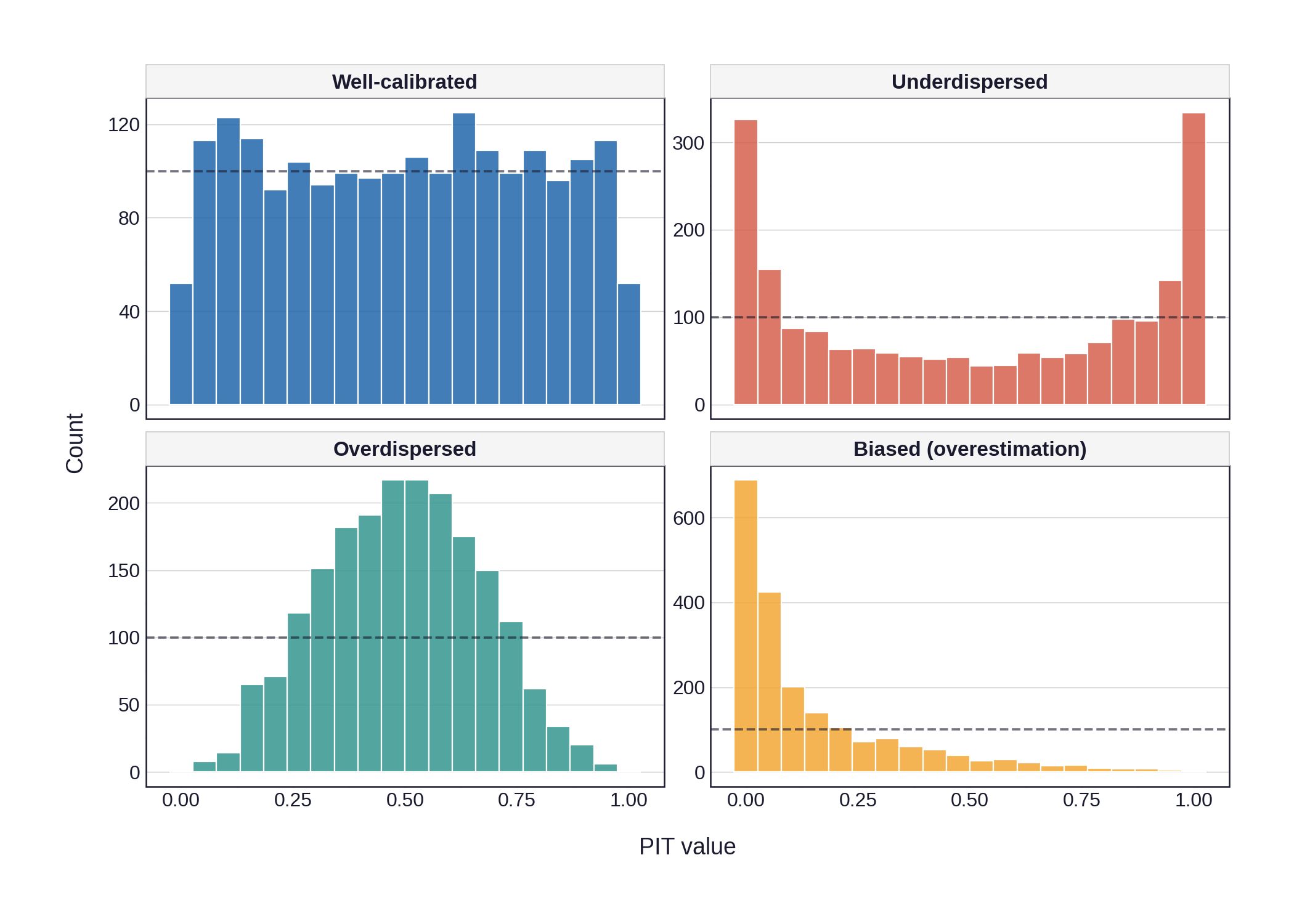
A histogram of PIT values that is approximately flat (uniform) indicates good calibration. Systematic deviations reveal specific deficiencies:

  • \(\cup\)-shape: underdispersion (prediction intervals too narrow).
  • \(\cap\)-shape: overdispersion (prediction intervals too wide).
  • Right-skewed (mass near 0): systematic overestimation (forecasted values too high).
  • Left-skewed (mass near 1): systematic underestimation (forecasted values too low).

To illustrate, we simulate PIT values from four scenarios: a well-calibrated forecast and three common miscalibrations.

Code
np.random.seed(42)
n = 2000

# Well-calibrated: PIT ~ Uniform(0,1)
pit_calibrated = np.random.uniform(0, 1, n)

# Underdispersed: true variance > forecast variance => U-shape
# Observations drawn from N(0, 2^2), forecast assumes N(0, 1)
y_underdispersed = np.random.normal(0, 2, n)
pit_underdispersed = stats.norm.cdf(y_underdispersed, loc=0, scale=1)

# Overdispersed: true variance < forecast variance => hump-shape
# Observations drawn from N(0, 0.5^2), forecast assumes N(0, 1)
y_overdispersed = np.random.normal(0, 0.5, n)
pit_overdispersed = stats.norm.cdf(y_overdispersed, loc=0, scale=1)

# Biased (overestimation): forecast mean too high => mass near 1
# Observations from N(0, 1), forecast assumes N(1.5, 1)
y_biased = np.random.normal(0, 1, n)
pit_biased = stats.norm.cdf(y_biased, loc=1.5, scale=1)

df_pit = pd.DataFrame({
    "PIT": np.concatenate([pit_calibrated, pit_underdispersed,
                           pit_overdispersed, pit_biased]),
    "Scenario": (["Well-calibrated"] * n + ["Underdispersed"] * n +
                 ["Overdispersed"] * n + ["Biased (overestimation)"] * n),
})
df_pit["Scenario"] = pd.Categorical(
    df_pit["Scenario"],
    categories=["Well-calibrated", "Underdispersed",
                 "Overdispersed", "Biased (overestimation)"],
    ordered=True,
)

fill_colors = {
    "Well-calibrated": ACADEMIC_COLORS["cobalt"],
    "Underdispersed": ACADEMIC_COLORS["vermillion"],
    "Overdispersed": ACADEMIC_COLORS["teal"],
    "Biased (overestimation)": ACADEMIC_COLORS["amber"],
}

p = (
    pn.ggplot(df_pit, pn.aes(x="PIT", fill="Scenario"))
    + pn.geom_histogram(bins=20, color="white", size=0.3, alpha=0.85)
    + pn.geom_hline(yintercept=n / 20, linetype="dashed",
                    color=ACADEMIC_COLORS["ink"], size=0.5, alpha=0.6)
    + pn.facet_wrap("~Scenario", ncol=2, scales="free_y")
    + pn.scale_fill_manual(values=fill_colors)
    + pn.labs(x="PIT value", y="Count")
    + theme_academic(base_size=9, grid="y")
    + pn.theme(
        figure_size=(7, 5),
        legend_position="none",
        strip_text=element_text(size=8, face="bold"),
    )
)
p
Figure 1: PIT histograms for four forecast scenarios. A uniform histogram (top-left) indicates calibration. Deviations reveal underdispersion (\(\cup\)-shape), overdispersion (\(\cap\)-shape), and location bias (skewed).

In practice, PIT histograms are the first diagnostic to check before comparing scoring rules across models. A model with a lower CRPS but a strongly non-uniform PIT histogram may be getting lucky on average while being systematically miscalibrated — a situation that is dangerous for decision-making.

For ensemble forecasts where the predictive CDF is not available analytically, the PIT can be approximated using the empirical CDF of the ensemble. Given an ensemble \(\{x_1, \ldots, x_m\}\) and observation \(y\), the rank-based PIT is \[ u = \frac{1}{m+1}\sum_{i=1}^{m} \mathbf{1}\{x_i \leq y\}, \] which avoids boundary effects at 0 and 1. For multivariate forecasts, one typically examines PIT histograms marginally (one per component) or uses the multivariate rank histogram.

5 Formal Model Comparison: The Diebold-Mariano Test

While scoring rules provide a natural ranking of forecasting models via their average scores, a critical question remains: is the observed difference in scores statistically significant, or could it have arisen by chance? The Diebold-Mariano (DM) test (Diebold and Mariano 1995) provides a formal answer.

Definition (Score Differential)

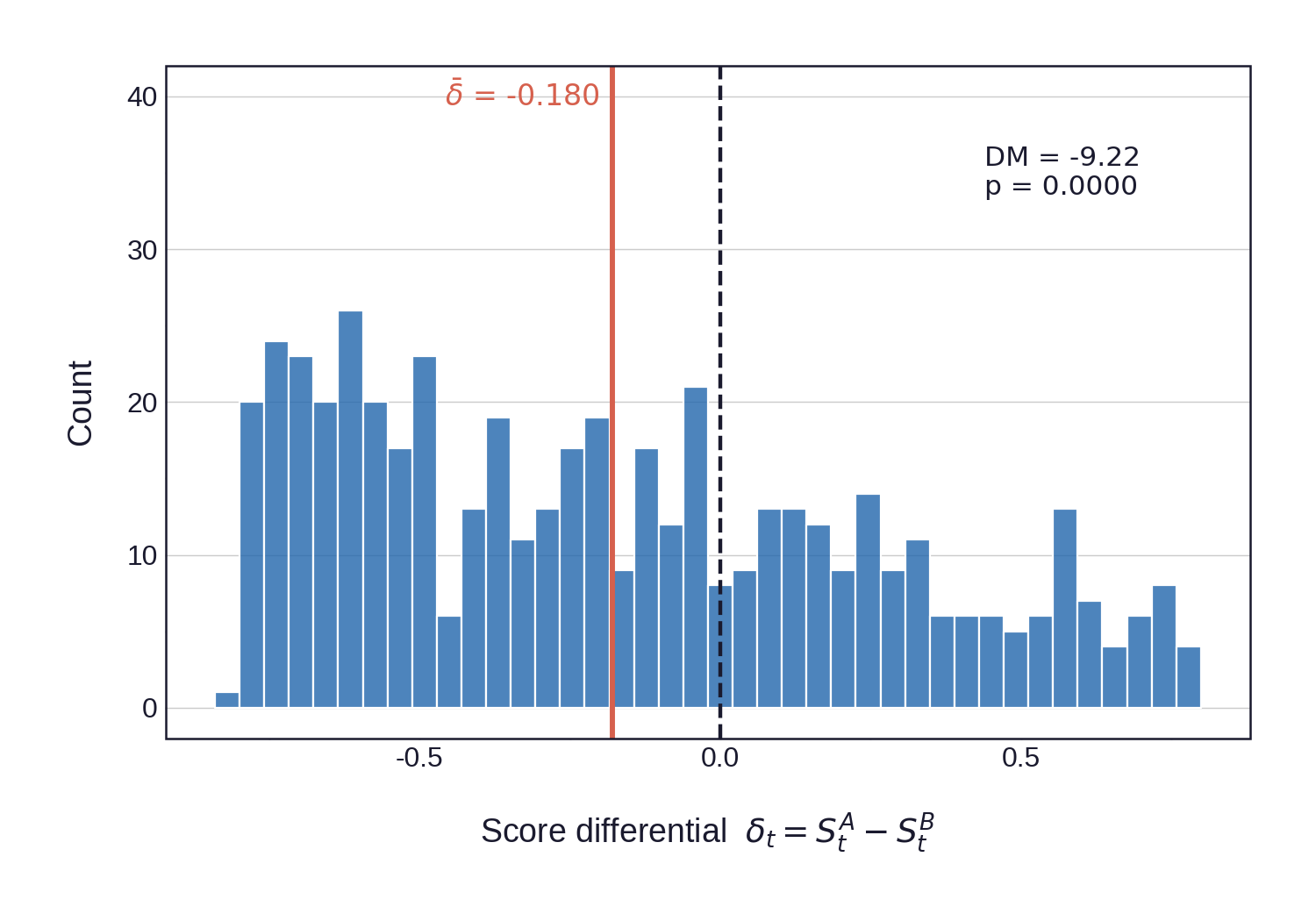
Given two competing forecast models \(A\) and \(B\) with score sequences \(\{S_t^A\}_{t=1}^T\) and \(\{S_t^B\}_{t=1}^T\) (e.g. CRPS values at each time step), the score differential is \[ \delta_t = S_t^A - S_t^B, \qquad t = 1, \ldots, T. \] Under negatively oriented scores (lower is better), \(\bar{\delta} < 0\) suggests that model \(A\) is superior.

Theorem (Diebold-Mariano Test) (Diebold and Mariano 1995)

Under the null hypothesis \(H_0: \mathbb{E}[\delta_t] = 0\) (equal predictive ability), the test statistic \[ \mathrm{DM} = \frac{\bar{\delta}}{\widehat{\sigma}_{\bar{\delta}}} \] is asymptotically standard normal, where \(\bar{\delta} = T^{-1}\sum_{t=1}^T \delta_t\) and \(\widehat{\sigma}_{\bar{\delta}}\) is a HAC (heteroskedasticity and autocorrelation consistent) estimate of the standard deviation of \(\bar{\delta}\).

For \(h\)-step-ahead forecasts, the score differentials are at most \((h-1)\)-dependent, and the long-run variance can be estimated as \[ \widehat{\sigma}_{\bar{\delta}}^2 = \frac{1}{T}\left(\hat{\gamma}_0 + 2\sum_{k=1}^{h-1}\hat{\gamma}_k\right), \] where \(\hat{\gamma}_k = T^{-1}\sum_{t=k+1}^{T}(\delta_t - \bar{\delta})(\delta_{t-k} - \bar{\delta})\).

Harvey, Leybourne, and Newbold (1997) propose a small-sample correction that replaces the normal reference distribution with a Student-\(t\) distribution with \(T - 1\) degrees of freedom and applies a finite-sample bias correction to the variance: \[ \mathrm{DM}^* = \mathrm{DM} \cdot \sqrt{\frac{T + 1 - 2h + h(h-1)/T}{T}}. \]

We now implement the DM test and demonstrate it on simulated forecasts.

Code
def diebold_mariano(scores_A, scores_B, h=1, harvey_correction=True):
    """
    Diebold-Mariano test for equal predictive ability.

    Parameters
    ----------
    scores_A, scores_B : array-like
        Score sequences for models A and B (lower = better).
    h : int
        Forecast horizon (for HAC variance estimation).
    harvey_correction : bool
        Apply the Harvey, Leybourne & Newbold (1997) small-sample correction.

    Returns
    -------
    dict with keys: statistic, p_value, mean_diff
    """
    scores_A = np.asarray(scores_A)
    scores_B = np.asarray(scores_B)
    delta = scores_A - scores_B
    T = len(delta)
    d_bar = delta.mean()

    # HAC variance (Newey-West with h-1 lags)
    gamma_0 = np.mean((delta - d_bar) ** 2)
    gamma_sum = 0.0
    for k in range(1, h):
        gamma_k = np.mean((delta[k:] - d_bar) * (delta[:-k] - d_bar))
        gamma_sum += gamma_k
    var_d_bar = (gamma_0 + 2 * gamma_sum) / T

    if var_d_bar <= 0:
        return {"statistic": np.nan, "p_value": np.nan, "mean_diff": d_bar}

    dm_stat = d_bar / np.sqrt(var_d_bar)

    if harvey_correction:
        correction = np.sqrt((T + 1 - 2 * h + h * (h - 1) / T) / T)
        dm_stat = dm_stat * correction
        p_value = 2 * stats.t.sf(np.abs(dm_stat), df=T - 1)
    else:
        p_value = 2 * stats.norm.sf(np.abs(dm_stat))

    return {"statistic": dm_stat, "p_value": p_value, "mean_diff": d_bar}
Code
np.random.seed(42)
T = 500

# Model A: well-calibrated N(0, 1) forecasts, true DGP is N(0, 1)
y_true = np.random.normal(0, 1, T)

# CRPS for N(mu, sigma^2): closed-form
def crps_normal(y, mu, sigma):
    z = (y - mu) / sigma
    return sigma * (z * (2 * stats.norm.cdf(z) - 1) + 2 * stats.norm.pdf(z) - 1 / np.sqrt(np.pi))

scores_A = crps_normal(y_true, mu=0.0, sigma=1.0)
scores_B = crps_normal(y_true, mu=0.8, sigma=1.0)  # biased model

result = diebold_mariano(scores_A, scores_B, h=1)

delta = scores_A - scores_B
df_delta = pd.DataFrame({"delta": delta})

p = (
    pn.ggplot(df_delta, pn.aes(x="delta"))
    + pn.geom_histogram(bins=40, fill=ACADEMIC_COLORS["cobalt"],
                        color="white", size=0.3, alpha=0.8)
    + pn.geom_vline(xintercept=0, linetype="dashed",
                    color=ACADEMIC_COLORS["ink"], size=0.6)
    + pn.geom_vline(xintercept=delta.mean(), linetype="solid",
                    color=ACADEMIC_COLORS["vermillion"], size=0.8)
    + pn.annotate(
        "text",
        x=delta.mean() - 0.02, y=40,
        label=f"$\\bar{{\\delta}}$ = {delta.mean():.3f}",
        color=ACADEMIC_COLORS["vermillion"], size=8, ha="right",
    )
    + pn.annotate(
        "text",
        x=max(delta) * 0.55, y=35,
        label=f"DM = {result['statistic']:.2f}\np = {result['p_value']:.4f}",
        color=ACADEMIC_COLORS["ink"], size=7.5, ha="left",
    )
    + pn.labs(
        x="Score differential  $\\delta_t = S_t^A - S_t^B$",
        y="Count",
    )
    + theme_academic(base_size=9, grid="y")
    + pn.theme(figure_size=(5, 3.5))
)
p
Figure 2: Diebold-Mariano test applied to CRPS score differentials. Model A (well-calibrated) vs Model B (biased). The distribution of score differentials \(\delta_t = S_t^A - S_t^B\) is centered below zero, confirming that Model A significantly outperforms Model B.

The negative mean differential \(\bar{\delta} < 0\) and the highly significant \(p\)-value confirm that Model A’s forecast quality is genuinely superior — the difference is not due to sampling noise.

5.1 Practical Considerations

  • Multiple comparisons: when comparing \(K > 2\) models, apply a correction (e.g. Bonferroni or the Model Confidence Set procedure) to control the family-wise error rate.
  • Score choice matters: the DM test can be applied with any scoring rule. Using the CRPS tests for overall distributional superiority; using a tail-weighted CRPS tests for superiority in the region that matters most for your application.
  • Autocorrelation: for multi-step forecasts (\(h > 1\)), the HAC variance estimator is essential. Ignoring autocorrelation in score differentials inflates the DM statistic and produces spuriously small \(p\)-values.
  • Sample size: the DM test is asymptotic. For small test sets (\(T < 50\)), the Harvey-Leybourne-Newbold correction with \(t\)-distribution critical values is strongly recommended.

6 References

Brier, Glenn W. 1950. “Verification of Forecasts Expressed in Terms of Probability.” Monthly Weather Review 78 (1): 1–3.
Dawid, A Philip. 1984. “Present Position and Potential Developments: Some Personal Views: Statistical Theory: The Prequential Approach.” Journal of the Royal Statistical Society: Series A (General) 147 (2): 278–92.
Diebold, Francis X, and Roberto S Mariano. 1995. “Comparing Predictive Accuracy.” Journal of Business & Economic Statistics 13 (3): 253–63.
Gneiting, Tilmann, Fadoua Balabdaoui, and Adrian E Raftery. 2007. “Probabilistic Forecasts, Calibration and Sharpness.” Journal of the Royal Statistical Society: Series B (Statistical Methodology) 69 (2): 243–68.
Gneiting, Tilmann, and Adrian E Raftery. 2007. “Strictly Proper Scoring Rules, Prediction, and Estimation.” Journal of the American Statistical Association 102 (477): 359–78.
Gneiting, Tilmann, and Roopesh Ranjan. 2011. “Comparing Density Forecasts Using Threshold-and Quantile-Weighted Scoring Rules.” Journal of Business & Economic Statistics 29 (3): 411–22.
Good, Irving John. 1952. “Rational Decisions.” Journal of the Royal Statistical Society: Series B (Methodological) 14 (1): 107–14.
Harvey, David, Stephen Leybourne, and Paul Newbold. 1997. “Testing the Equality of Prediction Mean Squared Errors.” International Journal of Forecasting 13 (2): 281–91.
Jordan, Alexander, Fabian Krüger, and Sebastian Lerch. 2019. “Evaluating Probabilistic Forecasts with scoringRules.” Journal of Statistical Software 90 (12): 1–37.
Matheson, James E, and Robert L Winkler. 1976. “Scoring Rules for Continuous Probability Distributions.” Management Science 22 (10): 1087–96.
Scheuerer, Michael, and Thomas M Hamill. 2015. “Variogram-Based Proper Scoring Rules for Probabilistic Forecasts of Multivariate Quantities.” Monthly Weather Review 143 (4): 1321–34.
Winkler, Robert L, José Muñoz, José L Cervera, José M Bernardo, Gail Blattenberger, Joseph B Kadane, Dennis V Lindley, Allan H Murphy, Robert M Oliver, and David Rı́os-Insua. 1996. “Scoring Rules and the Evaluation of Probabilities.” Test 5: 1–60.